





Reef Ecology Guide Phuket Thailand - Bony Fishes 1
BONY FISHES (Osteichthyes)

Although both major fish classes have the same primeval ancestry,
they have quite distinct characteristics. The bony fishes show an
appreciably greater number of innovative features, which has led
to explosive speciation: there are at least 36 species of bony fishes
for every cartilaginous one.
Among other features, bony fishes evolved the swim bladder, an extremely
useful piece of equipment, which enables its owner to maintain position
without any energy expenditure and at any chosen depth. The swim
bladder registers the change in pressure and automatically decreases
or increases the amount of gas required to maintain the specific
consistency of the entire organism against the water pressure at
a selected depth. Cartilaginous fishes were not involved in this
evolutionary process and to the present day have to make do without
this buoyancy aid.
Unlike the solely carnivorous cartilaginous fishes, bony fishes
have a wide range of food with plants, corals, flesh and plankton.
Eggs of bony fishes get fertilized outside the female's body.
The advanced evolution of bony fishes has enabled them to occupy
all ecological systems with many varied forms.
MORAY EELS (Muraenidae)
Families of eel like fishes, distinguished by continuous dorsal
and pectoral fins, building a hemline with the tail fin. Instead
of scales they have a thick skin. A layer of slime eases movement
through sharp-edged corals and rocks.
These nocturnal hunters spend
the day in crevices and caves. Moray eels are territorial and protect
their habitat furiously against invaders.
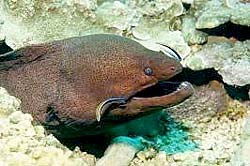
GIANT MORAY (Gymnothorax javanicus)
 Length:
to 2,5 m
Length:
to 2,5 m
Largest of all morays, encountered from 10 to 50 m depth.
This moray has an impressive dentition: the jaws bear canine teeth arranged in one row, which are laterally compressed and have sharp edges. The teeth at the front of the jaws are long and fang-like.
This moray is not shy and is frequently seen in daytime bduring dives at the Similans.
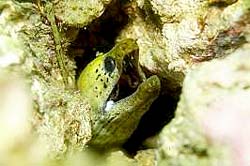
FIMBRIATED MORAY (Gymnothorax fimbriatus)
 Length:
to 1 m
Length:
to 1 m
This species is not very abundant in our area but still found at Phi Phi Island and the Similan Islands.
Seems to likethe steep sand slopes with many isolated outcrops of reef patches and sponges, in which the moray makes its home, especially where shrimps have well-established cleaning stations.

SCORPIONFISHES (Scorpaenidae)
Scorpion fishes are a complex family with about 10 subfamilies.
Scorpion fishes live close to the bottom, many of them well camouflaged and
lurking for prey.
All species of the family possess venomous spines with a sting that
produces extreme pain, followed by numbness. If stung, the best
thing to do is to apply heat to the wound as soon as possible, and
as hot as the victim can bear. Heat destroys the venom.
COMMON LIONFISH (Pterois volitans)
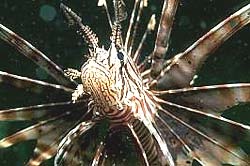 Length:
to 40 cm
Length:
to 40 cm
One of the most beautiful reef inhabitants, frequently seen singly or in small groups.
Lion fishes have a warning coloration of red and white, very long dorsal fin spines and greatly enlarged pectoral fins, often reaching past the anal fin.
They are hunting small fishes.
BEARDED SCORPIONFISH (Scorpaenopsis barbatus)
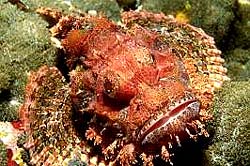 Length:
to 30 cm
Length:
to 30 cm
Inhabits coral reefs, where it lies motionless, relying on its camouflage and poisonous defensive stinging weapons.
STONEFISH (Synanceia verrucosa)
Length: to 40 cm
Probably the world's most venomous fish. It has grooved fin spines with associated poison glands in most fins.
This extremely camouflaged predator has a voracious appetite and feeds on fish and crustaceans.
ROCKCODS, GROUPERS AND BASSLETS (Serranidae)
The Serranidae are a highly diverse family with several major groups,
but classification is continuously under review. There are nearly
50 genera and well over 400 species, distributed worldwide.
The rock cods or groupers include larger fishes, sometimes of commercial
importance. They feature tiny, embedded scales and as adults have
small egg-shaped eyes. Most live alone and are territorial, claiming
caves and the larger species claiming the greatest reef sections. Diet comprises a variety of fish, cephalopods and crustaceans.
The basslets are small tropical species, most of which are schooling
planktivores but a few live on the substrate similar to the rock
cods. They feature small sized ctenoid scales and large eyes. The
caudal fin is usually deeply emarginated to greatly lunate.
CORAL ROCKCOD (Cephalopholis miniata)
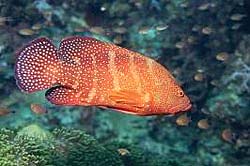 Length:
to 50 cm
Length:
to 50 cm
This grouper is typically found on well-developed coral reefs in clear water, often on exposed reefs with areas of rich coral growth.
The coloration of adults is variable. Juveniles are uniformly orange. The species feed on small fish and crustaceans.
BLUE-LINED GROUPER (Cephalopholis formosa)
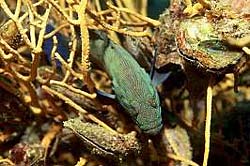 Length:
to 40 cm
Length:
to 40 cm
This grouper is a shallow-water species found in sheltered muddy, silty, or dead reefs, also in the vicinity of river mouths.
JEWEL FAIRY BASSLET (Pseudanthias squamipinnis)
Length: to 15 cm
In huge schools in the front of drop-offs, where they feed on plankton. Males are territorial with harems of many females.
Home |
Liveaboard Cruises |
Day Trips |
Diving Courses |
PADI IDC - CDC |
TEC Diving |
Dive&Save |
Reef Guide |
Phuket Guide |
About Dive Asia |
FAQ |
Links |
Contact us


Dive Asia - Phuket Thailand
Office Address: 23/6 Karon Rd, Kata Beach, Phuket 83100, Thailand
Phone: +66 (0) 76330598
Visit us at one of our Offices: (Google Map)
Email:
Website: www.diveasia.com
24 Hour Hotline: +66 (0) 818948588