





Reef Ecology Guide Phuket Thailand - Cnidarians 2
SEA ANEMONES (Actiniaria)

Anemones are closely related to reef-building hard corals. Essentially an anemone is nothing more than an overgrown coral polyp that lacks a hard skeleton.
As in many types of coral polyps the anemones tentacles contain a special type of alga known as zooxanthellae. It utilizes sunlight and carbon dioxide to produce high-energy substances (sugar), which are leaked to the host anemones, thus providing an important dietary supplement.
Because of their relationship with zooxanthellae, most of the large anemones achieve maximum growth in shallow, sun-lit waters. The alga is also responsible for imparting a greenish or brown hue to the tentacles.
Anemones can multiply by means of fragmentation. Sexual reproduction also occurs. Anemones normally feed on planktonic plants and small animals.
Some species live in symbiosis with fishes. Most fishes would be stung by the anemone, but clown fishes have a special mucus coating, which prevents the anemone from stinging them.
MAGNIFICENT ANEMONE (Heteractis magnifica)
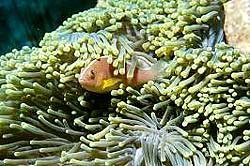
Exposed on hard substrates of drop-offs and slopes. The color is variable, tentacles greyish with yellowish tips.
Lives in symbiosis with clown fishes.
GIGANTIC SEA ANEMONE (Stichodactyla gigantea)
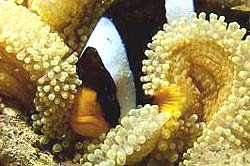
Settles from close to surface down to 30 m.
The body is smooth and folded. The carpet-like tentacles have strong stings.
BUBBLE ANEMONE (Entacmaea quadricolor)
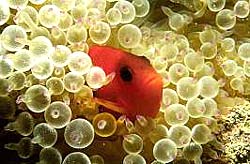
Very common at the Similans, but often unnoticed, because hidden in cracks on hard substrates.
The tentacles are swollen at the tip. Occurs in many different colorations, depending on the zooxanthellae.

JELLYFISHES (Cnidaria)
The Phylum Cnidaria, besides corals and anemones, also contains Jellyfishes. Although at first, it appears they have nothing in common, there are a few similarities that bind them. First and foremost is the basic body plan. Also, they have the same larval stage known as a planula.
Basically the medusa and the polyp are very similar in their organization, consisting of a soft body with tentacles clustered around a central mouth. In the medusa the mouth and the tentacles are usually directed downward, but in polyps they are typically directed upwards or laterally.
The sting of many jellyfishes is harmless; their stinging cells are not able to penetrate human skin. However a few species are capable of delivering very painful stings and a few can cause death. It is best to avoid contact with all of them, just to be on the safe side.
CROWN JELLYFISH (Rhizostomea spec.)
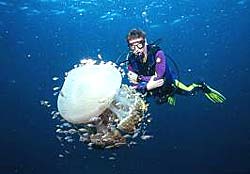
Length: to 50 cm
These jellies have a thick, fluffy frill between the upper bell and lower tentacles.
The central frill underneath actually contains numerous mouths, that are particularly efficient for trapping small organisms from the surrounding water.
Home |
Liveaboard Cruises |
Day Trips |
Diving Courses |
PADI IDC - CDC |
TEC Diving |
Dive&Save |
Reef Guide |
Phuket Guide |
About Dive Asia |
FAQ |
Links |
Contact us


Dive Asia - Phuket Thailand
Office Address: 23/6 Karon Rd, Kata Beach, Phuket 83100, Thailand
Phone: +66 (0) 76330598
Visit us at one of our Offices: (Google Map)
Email:
Website: www.diveasia.com
24 Hour Hotline: +66 (0) 818948588